The Godman of Ballygunge
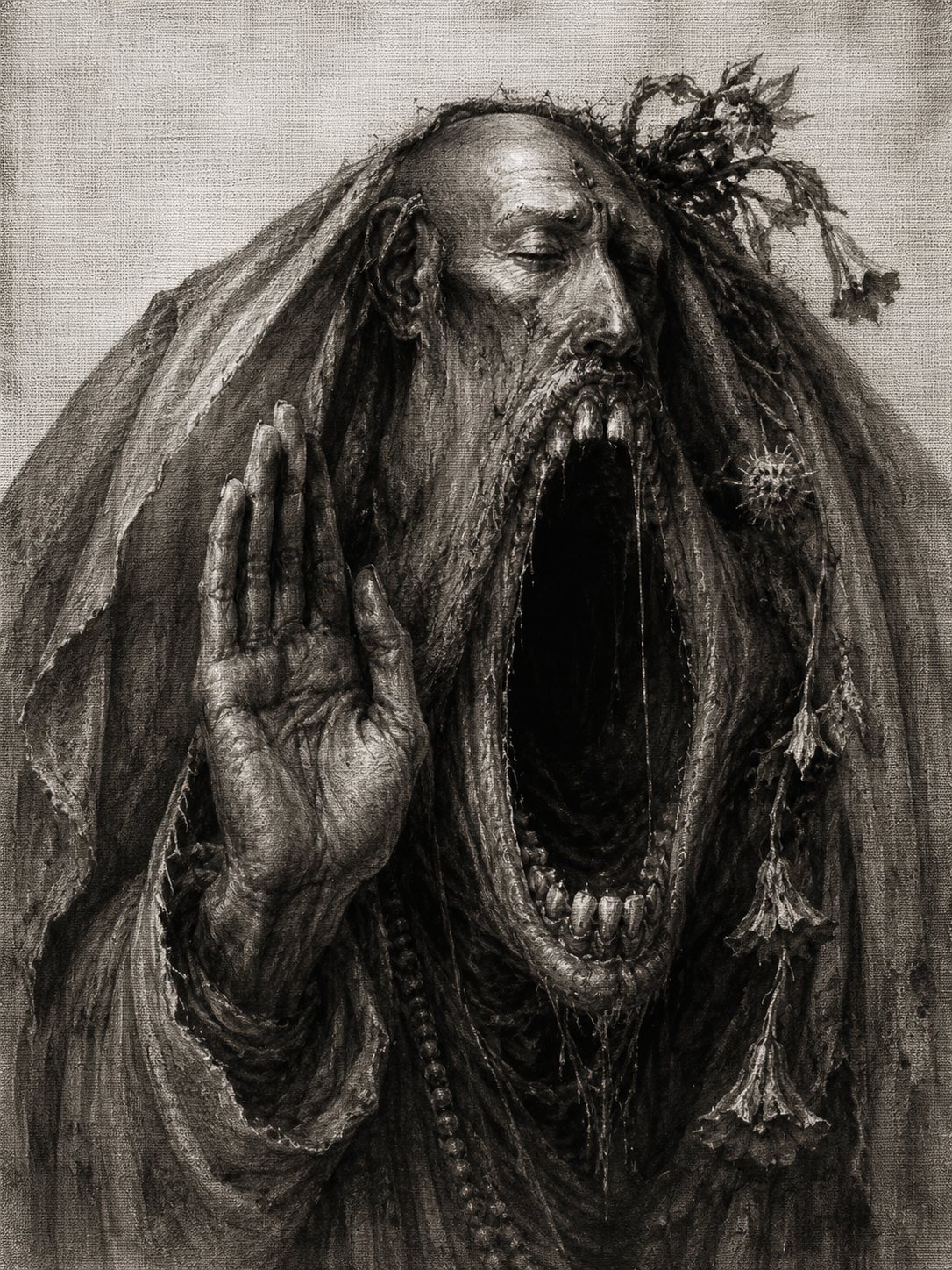
THIS IS A WORK OF FICTION
By the time the first woman walked into Ballygunge police station and said she had given Baba Shibananda her mother’s diamond bangles because Lord Shiva told her to, the para had already decided three things.
One, that the woman was unstable.
Two, that Baba was a saint.
Three, that the police should not interfere too much with religious matters, especially when the saint in question had recently donated two ceiling fans to the local club before Durga Puja.
This is how Calcutta protects fraud. Not with grand conspiracies, generally. That would require punctuality. Calcutta protects fraud with tea-stall opinion, with the weary shrug of men who know everything and do nothing, with the soft fungus of respectability growing over damp walls.
The woman’s name was Sanchari Dutta. Thirty-two, lecturer in English, divorced, daughter of a dead cardiologist and a mother who had once sung Rabindrasangeet so beautifully that people still said her voice had gone “straight to the puja lights.” Sanchari wore a plain kurta, no kajal, no bangle, no theatrical distress. This made everyone more suspicious of her.
“My locker is empty,” she said.
The sub-inspector asked, “You gave the key?”
“Yes.”
“Then where is robbery?”
Her mouth moved. No sound came out. Outside, in the wet lane, tea glasses clinked at Haru’s stall. A tram bell rang somewhere beyond the rain and traffic, a small civilized sound from a city pretending it had not become a large, badly managed fever.
“I don’t remember wanting to give it,” she said at last. “But I remember being happy.”
That was the sentence that brought the matter, three days later, to Riddhi Sen.
Riddhi was not a detective. He wrote crime and civic-corruption pieces for a Bengali web portal whose office above a cheap café in Gariahat smelled of damp plywood, burnt milk, and ambition past its expiry date. His editor, a woman named Mitali, had the spiritual temperament of a crow and the cardiovascular health of a retired bullock. She waved the complaint printout at him.
“Godman story,” she said. “Rich people, pretty women, cash, temple, possible drugs. Go.”
“Why me?”
“Because you still look poor enough to be sincere.”
Riddhi accepted this as praise. At thirty-nine, he had the soft beginnings of a belly, the eyes of someone who slept badly, and the moral posture of a man permanently leaning away from a debt collector. His father had died two years earlier in a private hospital near Mukundapur after three unnecessary procedures and one necessary one that came too late. Riddhi had written nothing about it. He had signed forms, paid bills, sold his mother’s thin gold chain, and learned that grief in modern India comes with a payment gateway.
Baba Shibananda’s ashram stood behind a peeling mansion near Ballygunge Place, in a lane where old houses with iron balconies watched new apartment towers rise like polished threats. The mansion had once belonged to a family of lawyers. Now its courtyard was full of plastic chairs, marigold garlands, incense smoke, framed gods, a donation box, two bored security guards, and posters of Baba’s face printed with the soft-focus glow usually reserved for fairness creams and deceased film stars.
The city had accepted him quickly. Of course it had. Calcutta is suspicious of success but sentimental about holiness, particularly holiness that speaks English to doctors, Bengali to widows, Hindi to businessmen, and silence to the police.
Riddhi first saw him on a Wednesday evening after rain.
The courtyard smelled of wet earth, sandalwood, drains, and frying batter from a telebhaja shop outside. Women sat in front rows. Men stood behind them, checking phones with devotional seriousness. Baba Shibananda emerged from a side room in white silk, his beard blacker than a crow’s wing, his forehead marked with ash, his eyes large and liquid and not, Riddhi thought, entirely sane.
Behind him stood three young women in identical pale saris. They were not the giggling kind of disciple one saw in television scandals. They were still, composed, watchful. One of them, tall, with cropped hair and a small scar at her chin, held a brass plate of flowers. Another kept her eyes lowered. The third looked directly at Riddhi.
It was not flirtation. It was inventory.
Baba raised his hand.
“Modern people,” he said in English, smiling, “have become very clever. So clever they have forgotten how to be saved.”
The crowd sighed, relieved to be diagnosed.
He spoke of stress, dead parents, ungrateful children, bad sleep, ancestral curses, property disputes, blocked promotions, foreign visas, court cases, womb problems, and the poison of greed. He had an excellent understanding of the Bengali middle class, which is to say he knew that every family has at least one unpaid bill, one unspoken shame, and one son whom everyone secretly considers a disappointment.
After the discourse, devotees lined up for blessings. Riddhi waited behind a promoter with a gold bracelet and a woman whispering into her phone, “No, Ma, he is genuine. You can feel vibration.”
When his turn came, Baba touched his head.
“You lost your father,” he said softly.
That was easy. Riddhi had not yet learned to stop carrying death on his face.
“You are angry,” Baba continued. “But not at the people who killed him.”
That was less easy.
Riddhi looked up.
Baba smiled. “You write?”
“Sometimes.”
“You must write truth.”
“Always?”
“Truth that heals,” Baba said. “Not truth that creates more mud.”
From the brass plate, the scar-chinned woman gave Riddhi a white flower shaped like a trumpet. Its throat was faintly purple, its smell thick and bitter under the incense.
“Dhutura,” she said.
Riddhi took it carefully.
“My grandmother said never keep it near children,” he replied.
Her eyes flickered. “Your grandmother was wise.”
Outside, Haru’s tea stall had expanded itself across half the pavement, as all successful Calcutta institutions eventually do. Men stood under a blue tarpaulin arguing about politics with the exhausted intimacy of people who knew nothing would change before the next cup. Rainwater trembled in potholes. A delivery rider, soaked to the underwear, cursed his app in three languages. Above the lane, old balconies leaned forward like gossiping aunties.
Riddhi bought tea. The scar-chinned woman came out five minutes later and stood beside him.
“Journalist-babu,” she said.
“Is it visible?”
“Only to people trained in seeing pests.”
“Useful training.”
“In this city, essential.”
Her name was Tuli. She had been, she said, a classical dancer from Jodhpur Park before an ankle injury ended one life and began another. She spoke evenly, without devotional sugar.
“How long have you been with Baba?” Riddhi asked.
“Long enough.”
“That is not an answer.”
“It is the safest one.”
He held up the flower. “Why give this to devotees?”
“Symbol of Shiva.”
“And poison.”
“Many holy things are poison if handled by fools.”
Behind them a bus honked with the fury of a trapped rhinoceros. Someone shouted, “Move, idiot!” Someone else shouted back something biologically ambitious. Calcutta continued, which was one of its crueller habits.
That night Riddhi searched. Not deeply at first; every reporter begins with laziness polished into method. The complaints were scattered. A businessman from Salt Lake had transferred twenty lakh as “ritual property cleansing.” An elderly widow in Lake Gardens had signed over a fixed deposit. A boutique owner from Hindustan Park had vanished for eight days and returned speaking of liberation, refusing to meet her husband, then later remembered nothing clearly except white flowers and a silver cup.
No FIR had survived family embarrassment. The rich prefer private ruin to public ridicule. Their respectability sits on their heads like an expensive wig; even in fire they first reach to hold it down.
Mitali listened to Riddhi’s findings with bright disgust.
“Drugging?”
“Maybe. Dhutura has a reputation.”
“Can we write that?”
“Not yet.”
“Can we imply?”
“We can imply weather, if needed.”
“Find a doctor.”
He found one in a government hospital near Park Circus, an old toxicologist named Dr. Farzana Rahman, who had the splendid tired face of someone who had seen all human stupidity and still came to work.
“Dhatura?” she said. “Very old story. Village crime, city crime, fake saints, thieves at stations. Confusion, obedience, hallucination, memory gaps. Dangerous. Unpredictable. People die.”
“Can someone use it to make another person willing?”
Dr. Rahman looked at him over her glasses. “Willing is a philosophical word. Drugged is medical. Do not mix.”
“Could a victim appear happy?”
“Of course. A man with high fever may also smile at a wall.”
“Can it be detected?”
“Depends when tested. Depends what was taken. Depends whether anyone in our beautiful system cares before the evidence has gone off like yesterday’s fish.”
“Could someone dose himself accidentally?”
She leaned back. Outside her office, a child cried. A nurse shouted for gauze. Somewhere a ceiling fan clicked like a small bureaucratic curse.
“Men who play with poison,” she said, “eventually become confident. Confidence is how poison gets its second meal.”
Riddhi liked her immediately.
The second woman came to him directly.
Her name was Ira Bose, twenty-six, influencer, daughter of a construction supplier, fiancé to a man in Dubai whose Instagram contained more watches than expressions. She arrived at the café below Riddhi’s office wearing sunglasses indoors and trembling so hard her iced coffee rippled.
“I was with him for three months,” she said.
“With Baba?”
“With the ashram. With them. I don’t know.”
“What happened?”
“I thought I had chosen it. That is the worst part.” She removed her sunglasses. Her eyes were raw. “I thought my family was vulgar. My fiancé was vulgar. Money was vulgar. My body was vulgar unless Baba purified it. Everything became simple around him. Give this. Sign that. Sit here. Smile. Don’t call home. Your mother’s tears are Maya. Your father’s anger is ego. Your own fear is past-life dirt.”
“Did he touch you?”
She looked away.
Riddhi waited.
“Not like that,” she said. “Worse, maybe. He made me grateful. He made me feel chosen. Then one day the room tilted and I saw his face without the light.”
“What does that mean?”
“I mean his face was just a face.”
She told him about evening drinks called charanamrit, about flowers crushed into ritual ash, about private blessings in a room with blue curtains, about women told they were vessels of Shakti and men told their wealth was cursed unless surrendered. She remembered fragments: a silver cup, a song from an old Hindi film playing somewhere, Baba laughing with someone after she was supposed to be asleep.
“Who helped him?” Riddhi asked.
“The women.”
“Tuli?”
Ira stiffened. “Tuli is dangerous.”
“Because she believes?”
“Because she doesn’t.”
The article went up on a Friday morning with no direct accusation, only questions. By lunch it had spread through WhatsApp groups, where truth becomes both faster and stupider. By evening Riddhi had received seven threats, two invitations to television debates, one message from an unknown number saying STOP BEFORE YOU LOSE YOUR MOTHER, and a call from Mitali telling him the portal owner wanted “balance.”
“Balance?” Riddhi said.
“Meaning we should not be sued by a man with devotees in the police.”
At nine that night, the lights went out in Riddhi’s building in Santoshpur. Power cuts had become rare enough to feel personal. He stood by the window in the damp dark, hearing pressure cookers hiss in neighboring flats, a baby crying, an old man coughing, scooters gurgling through lanes below. His phone glowed in his hand.
The unknown number sent a photo.
His mother, sitting in the courtyard of Baba Shibananda’s ashram.
Riddhi did not remember the taxi ride clearly. He remembered rain beginning again. He remembered puja lights being tested early in a lane, blinking red-blue-green on puddles. He remembered a metro announcement at Kalighat, metallic and calm, as if the city’s underground voice had achieved enlightenment by giving up hope.
The ashram gate was half-open.
Inside, the courtyard was empty except for wet plastic chairs. Incense burned before a black stone Shiva. Somewhere in the mansion, a woman laughed. Then stopped.
Riddhi found his mother in the inner hall, sipping tea from a clay cup.
She was seventy-one, diabetic, sharp-tongued, and generally immune to holiness. She looked annoyed rather than enchanted.
“Why have you come running like goat?” she said.
“Ma, what are you doing here?”
“This girl brought me.” She nodded toward Tuli, who stood near the staircase. “Said you are in danger and I should sit here where they can see me. Very bad tea.”
Riddhi turned to Tuli.
“You threatened me?”
“No,” she said. “I warned you in a language men understand.”
“By using my mother?”
“Would you have come otherwise?”
From upstairs came Baba’s voice. “Bring him.”
The room with blue curtains was smaller than Riddhi expected. There was a divan, a brass lamp, framed gods, an air conditioner dripping into a bucket, and a faint smell beneath the sandalwood—green, bitter, bruised.
Baba sat on a cane chair. Without the crowd, he looked older. Not ancient, only used. His beard dye showed at the skin.
“My son,” he said, “you have made trouble.”
“You kidnapped my mother.”
“She came for blessings.”
“My mother blesses people by criticizing their cholesterol.”
Baba smiled. “Sit.”
“No.”
Two guards appeared behind him. Riddhi sat.
Baba leaned forward. “Do you know what suffering is? Not your newspaper suffering. Real suffering. People come to me broken by money, sex, loneliness, children abroad, husbands drunk, wives bored, bodies failing. I give them relief.”
“You rob them.”
“I remove burden.”
“You drug them.”
“I loosen the knot. Modern mind is too tight. A little divine plant, a little mantra, and truth comes out.”
“Bank passwords also.”
Baba’s smile thinned. “Careful. You think cynicism is intelligence. It is only failed tenderness.”
The words struck too near. Riddhi hated him for that.
Tuli stood behind Baba now, face unreadable. The other two women flanked the door.
“Why women?” Riddhi asked.
Baba’s eyes shone. “Women understand surrender.”
“No,” Tuli said.
The room changed.
Not dramatically. No thunder. No cinematic wind. Only a small failure in arrangement, as when a familiar sentence suddenly reveals a hidden insult. Baba turned.
Tuli held a silver cup.
He stared at it. “What is this?”
“Your nightly courage,” she said.
The two women at the door moved aside. Ira Bose stepped in from the corridor. Behind her came Sanchari Dutta. Behind Sanchari, three more women Riddhi had seen only as blurred complaint photographs, respectable daughters and wives and professionals whose families had buried the story under shame.
Baba stood too quickly. “What is this drama?”
Tuli’s voice remained calm. “You taught us that fear is Maya.”
“You ungrateful—”
“No,” said Sanchari. “Gratitude was the drug.”
Baba looked at the cup again. His pupils seemed too wide.
Riddhi understood then that the overdose had already happened. Not by his hand. Not exactly by theirs, perhaps. The room smelled of flowers.
“You gave him—” he began.
Tuli looked at him. “He prepared everything himself. We only stopped protecting him from his own appetite.”
Baba laughed. It came out wrong, high and torn. He lifted his hands as if blessing an invisible crowd. Sweat rolled down his temples. His eyes moved from woman to woman, but whatever he saw was no longer in the room.
“Ma,” he whispered.
The lamp flame bent sideways though the air conditioner was off.
Riddhi heard bells. Not temple bells. Tram bells, bicycle bells, school bells, hospital call bells, the tiny ringing of spoons against tea glasses across the city. The sound gathered in the walls. The blue curtains darkened until they looked almost black.
In the corner behind the divan, where damp had bloomed through plaster, a plant was growing.
That was impossible, naturally, and therefore everyone saw it.
A green stem pushed from the wall with the obscene patience of something that had all night and several centuries. Leaves unfolded, soft and toothed. White trumpet flowers opened one by one, their mouths pale as bone.
Baba began to cry.
“I served you,” he said to the plant.
The flowers trembled.
Riddhi wanted to stand, to leave, to take his mother and run back into the ordinary corruption of taxis and potholes and unpaid bills. But his body would not move. No drug held him. Only terror, that ancient municipal authority before which even journalists become compliant.
Baba sank to his knees.
The women watched him. Their faces showed no triumph. This disturbed Riddhi more than triumph would have. Revenge, when pure, has heat. Their faces were cool, exhausted, almost administrative.
The plant’s shadow climbed Baba’s white silk. He clawed at his throat.
“I am your son,” he gasped.
Tuli whispered, “No. You were only the priest.”
Then Baba Shibananda looked at Riddhi with a child’s astonishment.
“They were never mine,” he said.
His body convulsed once, twice, then folded forward on the floor.
No one touched him.
Outside, the rain strengthened, drumming on the old mansion roof, washing the courtyard chairs, filling the lane, carrying marigold petals toward the drain. Somewhere beyond the gate, Haru’s tea stall radio played a devotional song in a singer’s sweet, injured voice. The city did not pause. It had seen saints before. It had seen worse.
The police report later said accidental poisoning. The television channels said controversial spiritual leader found dead. His devotees said conspiracy. His enemies said justice. The rich said very little and instructed lawyers. The ashram was sealed for nine days, then quietly reopened by a cousin with a smaller beard and better accounting.
Riddhi wrote no article.
This surprised Mitali, who accused him of laziness, cowardice, bribery, and finally taste.
“What happened in that room?” she demanded.
“A man overdosed on his own myth,” he said.
“Very literary. Useless for traffic.”
He kept the white flower Tuli had first given him in a glass jar on his desk, though it should have shriveled. It did not. Some nights, when power dipped and the fan slowed to a helpless paddle, its closed trumpet turned slightly toward him.
His mother asked once why he kept that nasty thing.
“For evidence,” he said.
But that was not true.
A month later, a courier came with no return address. Inside was a small notebook bound in red cloth. Baba’s handwriting filled the pages: names, amounts, weaknesses, family secrets, rituals, dates. Riddhi found Sanchari, Ira, the Salt Lake businessman, the widow from Lake Gardens.
Near the end, he found his own father’s name.
Not as a victim.
As a donor.
Beside it, in Baba’s neat black script, were three words: son will come.
Riddhi sat until evening in the cheap café below his office while rain stitched the city shut and opened it again. When he finally returned home, the flower in the jar had bloomed, and from its pale throat came the faint, unmistakable smell of hospital disinfectant, burnt milk, and his father’s hair oil.
He did not throw it away.